Showing posts with label wasiniisland. Show all posts

Monday, July 22, 2013

Kenya : Cradle of Mankind

I am particularly very proud to be Kenyan today ; I think every Kenyan should be. Have you noticed that in many international movies and television series you will find a mention of Kenya come up? It gets better when it's for good reasons unlike many other African countries; mostly it's about safaris. It's a fantastic feeling knowing we are among the best when it comes to
wildlife
and safaris.
Irregardless, I believe I have another reason to be proud of Kenya here. Do you believe in the theories of evolution?  Well, if you do, you have to know that
Kenya is said to be the
cradle of mankind. Nonetheless, Ethiopia and South Africa claim the same 'title'.
In respect to that, The National Museum of Kenya has a list of factual support to the 'claim' as the cradle of mankind and it is as follows ;

Kenya has the largest number of
fossil human remains appr. 1000
individuals than any other country
in Africa.

Kenya has the oldest human remains
going back to 7 million year old from
Turgen Hills, Baringo (oldest in
Ethiopia = 4.5 million years ;
S.Africa ca 3 million years, Tanzania
= 2 million years.

Kenya has some of the most
complete skeletons e.g Turkana Boy
(1.6 Million years), which provided a
great wealth of information
regarding early human physiology
than anywhere in the world.

Kenya is endowed with many
prehistory sites scattered all along
the Rift Valley (north to south) and
western Kenya.

Kenya has many earliest ape sites
particularly in western Kenya. These apes are ancestors for earliest
humans. Ethiopia has just a handful
of these earliest sites thus making
Kenya the probable place where
transition from ape-like to human-
like beings occurred.

Kenya has the longest and most
complete record of human evolution
(and possibly the link between
humans and apes).

There is a huge collection in regards
to prehistory finds. Kenya actually
has the largest collection of human
related fossils anywhere in the
world. This collection is well
documented and can be found in
one central place- National Museum of Kenya Headquarters

Not only are all species of hominids
represented but also some other
faunal and plant species that relate
to the evolutionary theory (e.g.
elephants, giraffes, crocodiles and
even the dinosaurs).

In addition to the fossil record,
there is a long record of
technological evolution (with tools as
old as 2.3 million years).
There is a wide environmental
representation (open and closed
sites) in regards to evidence of
fossils and tools. Each region in
Kenya has a story to tell in regards
to the story of human origin. Varied
environments that may have been
instrumental in the evolution of both
humans and other species.

There is a wide genetic
representation among some of its
people (Turkana) pointing to the fact
that humans have been here for a
very long time.

There is a connection with the Far
East through the Red Sea where
humans are believed to have
dispersed from to other regions of
the world.
There is evidence of other factors
that relate to the evolution of
humans (e.g. humanity made fire as
far back as 1.8 Million yrs, footprints at
1.55 million yrs).

The study of human evolution began
in the early 20th century and
continues to present.
Kenya has about 20 Miocene (23.03
million years ago -ma to 5.3 Ma)
sites while Ethiopia has only two at
the moment.

I think the evidence is pretty credible. The Rift Valley especially has most sites and in consideration to the area's local climate, I second that evidence.
Some of the prehistoric sites that have been sources of fossil evidence are ;

Enkapune Ya Muto
Enkorika
Hyrax Hill
Ileret
Kapthurin
Koobi Fora
Ngenyn
Olorgesailie

Numerous fossils and tools collected from these sites are well preserved at the prestigious National Museums of Kenya which are distributed all over Kenya. Headquarters are located within the busy capital -Nairobi.

Aside from the prehistoric sites, Kenya boasts a rich archaeological history that has caught interest of many archaeology tourist especially with a particular interest to study that history. Some of the sites are:

Jumba la Mtwana
Kiongwe
Lamu
Mambrui
Manda Island
Namoratunga
Pate Island
Ruins of Gedi
Takwa

Each of these sites plus many more have a uniquely tasteful history that all together make the country that is Kenya is today. These sites are priceless riches that we should continue guarding for our benefit and generations to come.
Facts source : National Museum of Kenya
© Msafiri Kenya Blog

Saturday, July 20, 2013

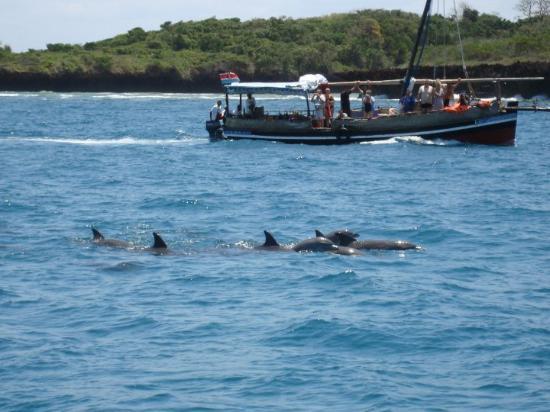
Wasini Island : The Kenyan Dolphin Waters

Ever had a place in your life or a destination that you would consider 'heavenly' or
simply put 'paradise on earth'? I guess I finally found one that does the magic for me ; Wasini Island.
A beautiful coral island located in the south east Indian Ocean
coast of Kenya near Shimoni and 10 km away from Kisite- Mpunguti Marine park, this island has a lot to offer a tourist.
A tour in this area would encompass a great variety of wild adventures in a wild coral
island.
With the scarce local population,wild mangrove forests and practice of eco- tourism, the island is almost intact and perfect for adventure.
Wasini Island is well famed as an excellent place for spotting for dolphins. For the adventure- seeking msafiri, you wouldn't want to miss a chance at snorkeling while having a swim with the dolphins- probably the most intelligent sea creatures. I'd bet this experience is one worth the history books.
If you'd ever want an experience fishing here, there are a lot of sports fishing
vessels that go straight through the
Pemba Channel, and it is a fishing
ground that’s well-known in Kenya,
World IGFA, and All Africa fishing
records with bountiful fish varieties.

Take an adventure walk of its own kind in the coral gardens on
the Western end of the island,
women groups have set up a nature
walk in it. Here you get to view plenty of colourful fishes in the sapphire oceanic waters. The proceeds go toward
Wasini benefactors, including Wasini
students. Here tours are usually packaged prior to the visit to the island hence making
it easier to include all activities in your package. This tour won't take much of your time
so you could make a detour visit in your planned tour. What's more? Clean Sun- kissed empty beaches around it,
definitely an escape from crowded beaches, would
certainly do for a peaceful afternoon.
Finally,
what's a tour to Wasini Island without a visit to the exquisite Charlie Claw's Restaurant?
Get served with finger-licking seafood delicacies at a
fair price here to complete the tour of this paradise.
This is the one island that would beg the question,
'what better place could you ever visit? ' Given a chance,
I would sacrifice all savings just to seize this exhilarating, once in a lifetime experience- seriously , it's worth the praise.

Monday, July 15, 2013

The Wildebeest Migration : The World's Eighth Wonder

As it is known,annually the Masai Mara Game Reserve is the most sought safari destination in Africa and perhaps worldwide. Some have coined it as the '8th wonder of the world'. Annually, the wildebeest migrate from the Serengeti National Park in Tanzania across the crocodile infested Mara River into the Masai Mara Game reserve. Similarly, tourist from all over the world traffic into Masai Mara Game Reserve for the chance to experience of a lifetime.

Why the migration?
Many are ignorant as to the reason for the herds migration.
The wildebeest migration is a natural phenomena just like the American bison migration which happens every year. In the Mara, annually a population of approximately 1.5 million wildebeest and about 200,000 zebras and some gazelles set for a migration across the Mara River in search of surface drinking water and greener pastures in the months of April to July. It is said that this migration is triggered by the animals' instinct although weather patterns such as the wind direction guide them.

As the huge populous herds migrate to and fro, they are are constantly faced by a challenge of predator attacks which reduces their population. Numerous documentaries feature wildebeest being eaten by crocodiles , land predators or drowning in the river. An adult wildebeest is pretty strong and fast - running at a maximum of 80km/h (50mph). Their horns could easily tear and injure a predator, even a strong lion. A recent research has shown that a herd of wildebeest possess what is known as " swarm intelligence" whereby animals systematically explore and overcome obstacle as one. Typically, predators attempt to segregate or cut out the weak, sick and young animals of the herd. Swarm intelligence enables the older and larger animals to protect the younger and weaker ones while the herd runs as a group.

Migration patterns
The wildebeest live in the Serengeti National Park in Tanzania for 8 months and live in the Masai Mara Game Reserve for two months. The rest of the time is spent in the migration.  They migrate to The Mara for surface drinking water and bountiful greener grass rich in phosphorus . The rich grasses are particularly important for the lactating 'mothers' of the herd. This migration happens around the rainy seasons of April until around July and it is during their duration in the reserve that they give birth to thousand of new healthy calves before they migrate back to the Serengeti.

What about the wildebeest? 

Here are some brief facts animal
facts about the wildebeest

There are two species of
wildebeest:
The Blue Wildebeest or the
brindled gnu (species Connochaetes taurinus )
The Black Wildebeest or the white
tailed gnu (species Connochaetes gnou)
Size: Male - 58" Female - 53"
Height: 3 ft 9 inch to 4 ft 7 inch
(1.1 m to 1.4 m)
Weight:330 to 550 lbs (150 to 250
kg)
Habitat: The plains and open woodlands of Africa, especially the Serengeti National Park, a UNESCO World Heritage Site in Tanzania, Masai Mara Game Reserve in Kenya, and Liuwa Plain National Park in Zambia.

Lifespan:20 years
Predators:Leopards, Lions, hyenas, African wild hunting dogs and cheetahs
Food: tree leaves, grass, ferns, fruit and fungi

When and where is it best to view the migration?

Masai Mara is a year round safari destination. However, the migration is it's biggest attraction. A great majority of tourist prefer viewing the migration from the Mara side as opposed to the Serengeti. The Mara provides a stunning spectacle of the whole migration. For eco-friendly and conservative tourist, a view in a a hot air balloon or a chattered aircraft is breathtaking.
The best visit times are between April and July and in November. It's advised that one makes an early visit to avoid the tourist traffic to the park. Although the timing changes from time to time, it doesn't differ much. Also, the spot of migration changes from one year to the other.

Have you, the msafiri, had your chance at this often "once in a lifetime " opportunity? Do you plan to take that step? Personally, I can't wait.

WELCOME MSAFIRI!!

Wednesday, July 10, 2013

LAIKIPIA NATIONAL PARK: The Mammal Sanctuary

Staring in the northern tourism circuit of Kenya is the Laikipia
National Park.
Increasingly acknowledged as one of
the most important areas for biodiversity in Kenya, wildlife
population densities in the Laikipia
region and Ewaso eco-system now
rank second to the internationally
renowned Maasai Mara ecosystem ,whilst the diversity of large
mammals is higher than in any
other part of Kenya.
The Ewaso eco-system is home to the
second largest population of
elephant in Kenya (5,400) and the
area hosts the highest populations
of endangered species in the country.
Laikipia supports seven heavily protected rhino sanctuaries, which together hold over half of Kenya’s
black rhino population. Laikipia has a unique combination of dry and
cool weather, climatic gradients
being influenced by the presence of
Mount Kenya (5,199 metres) and the
Aberdare highlands (3,999 metres).
There is great variation in rainfall
from year to year.

Location - Laikipia

Laikipia District is a vast plateau to
the north west of snow-capped Mount Kenya, straddling the equator
at the heart of Kenya’s Rift Valley
Province. The Laikipia plains stretch from the Great Rift Valley to magnificent escarpments that
descend into the Northern Frontier
District.

Distance from Nairobi - 190km to
Nanyuki (Laikipia boundary)

Size

Covers total area of over 9,500
square km, and forms part of the
40,000 square km Ewaso ecosystem.

Climatic conditions:

Mean annual rainfall varies from
400mm in the north-east to 900mm
in the south-west. On average over
80 per cent of days are rain-free. The
long rains from March to May are
followed less rain between July and
September, with cooler temperatures
and high winds. The warmest
months are December and January,
which also have the least rainfall.

Wildlife:

The diversity of large mammals is
higher than any other area with
elephant, rhino, Grevy’s zebra,
reticulated giraffe, Lelwelhartebeest,
wild dog and large numbers of other
large predators.

Access

Road: access by road from Nairobi,
Samburu, Nakuru.

Air: Nanyuki
airfield is the hub for scheduled and
charter flights linking Laikipia with
destinations such as Samburu and
the Masai Mara. Most tourism
facilities in the region have private
airfields for charter flights.

Best time:

All months except April, May and
November, during the rainy season

Activities:

Wildlife related activities (day and
night), walking, hiking,fishing,
mountain climbing, mountain biking,
camel and horse riding and fly camping.